

RHODE ISLAND CRIMINAL RECORD EXPUNGEMENT & SEALING
put your past behind you.

An old criminal record can affect employment, housing, education, professional licensing, and future opportunities. Rhode Island law allows many arrests and convictions to be sealed or expunged, but eligibility depends on the specific facts of each case.
CK Law helps individuals throughout Rhode Island determine whether they qualify and guides them through every step of the process.
why expungement matters

EMPLOYMENT

HOUSING
PROFESSIONAL LICENSING

PEACE OF MIND

IMMIGRATION
WHY CHOOSE CK LAW?
-
Rhode Island's expungement laws are detailed, technical, and constantly evolving. Determining whether a record is eligible often requires a careful analysis of criminal history, court records, waiting periods, and statutory exceptions. Choosing an attorney with substantial experience in this area can make a meaningful difference.
For more than three years, Attorney Chelsea Kelly led the creation and development of the Expungement Unit as a RI Public Defender. During that time, she helped thousands of Rhode Islanders pursue a fresh start by evaluating eligibility, preparing complex expungement and record-sealing petitions, and representing clients throughout the process.
Her experience extends beyond the courtroom. Attorney Kelly has presented at legal conferences and professional trainings on Rhode Island expungement law, educating attorneys, students, and legal professionals on the state's eligibility requirements and procedures. She combines that depth of knowledge with a commitment to helping clients move forward with confidence.
-
Former lead attorney of RIPD Expungement Unit.
Tens of thousands expungement and record-sealing motions prepared and handled.
Helped thousands of Rhode Islanders clear eligible criminal records.
Recognized speaker and presenter on Rhode Island expungement law.
Extensive experience analyzing complex eligibility issues under Rhode Island law.
Represented clients in expungement hearings throughout Rhode Island.
-
Every record is different. Before assuming you do—or do not—qualify for an expungement, have your criminal history reviewed by an attorney with extensive experience applying Rhode Island's expungement laws.
Frequently Asked Questions
Still have questions? Take a look at the FAQ or reach out anytime. If you’re feeling ready, go ahead and apply.
-
Sealing and expungement are different legal processes. Generally, sealing applies to cases that did not result in a conviction, while expungement typically applies to eligible convictions.
A Rhode Island criminal case may be eligible to be sealed when:
The case was dismissed in its entirety;
The defendant was found not guilty; or
The case was resolved through a filing following a plea of nolo contendere and the filing period was successfully completed.
A successfully completed filing should generally be automatically sealed at the end of the filing period. However, court and criminal-history records do not always update as expected. If an old filing or dismissed case is still appearing on your Rhode Island criminal record, it may be necessary to determine whether additional action is needed to have the record properly sealed.
Expungement, on the other hand, generally applies when a case resulted in an eligible conviction or sentence and the applicable statutory requirements for expungement have been satisfied.
Because a criminal record may contain a combination of convictions, dismissals, filings, and other dispositions, a complete record review can determine which cases should be expunged, which should be sealed, and whether cases that should already have been sealed are still appearing on your record.
-
Rhode Island law establishes different waiting periods depending on the number and type of convictions on your record. As a general rule:
One misdemeanor: 5 years from completion of the sentence.
One eligible non-violent felony: 10 years from completion of the sentence.
Multiple misdemeanors: 10 years from completion of the most recent sentence.
Multiple eligible felonies: 15 years from completion of the most recent sentence.
Not every conviction is eligible for expungement. Rhode Island law specifically defines which felony offenses are considered “crimes of violence,” and certain offenses may be excluded from expungement altogether.
The waiting period is only one part of determining eligibility. Your entire criminal record, the specific offenses involved, how each case was resolved, and when each sentence was completed should be reviewed before determining whether you qualify for expungement.
-
Yes, but Rhode Island law places specific limitations on the expungement of DUI and domestic violence convictions.
As a general rule, a person may seek expungement of a domestic violence offense that resulted in a sentence of probation or incarceration, or a DUI offense, only if the person qualifies as a first-time offender and the sentence for that offense was completed more than five (5) years before filing the motion to expunge.
This is an important distinction because DUI and domestic violence convictions are treated differently from many other offenses under Rhode Island’s expungement laws. Even when a conviction is old, eligibility depends on whether the individual satisfies the statutory requirements for first-time-offender expungement.
Because these rules can significantly affect eligibility—particularly when a person has other cases on their record—a complete review of the criminal history is important before filing for expungement.
-
Expungement eligibility is often determined by your criminal record as a whole—not simply the case you want removed. Reviewing the complete record can identify additional cases that may be eligible for expungement or sealing and help avoid filing a motion under the wrong provision of Rhode Island law.
-
In most cases, an attorney can appear in court on your behalf, meaning you may not have to personally attend the expungement hearing. This can make the process significantly easier by avoiding the stress of appearing in court, taking time away from work, or rearranging other responsibilities.
There are, however, certain circumstances where the Court may require the petitioner to appear personally. Depending on the case and the particular Court, you may also be asked to provide documentation demonstrating rehabilitation and positive changes since the time of the conviction or completion of the sentence.
At CK Law, we handle the court filings and appearances whenever permitted and will let you know in advance if your personal appearance or additional documentation is required.
-
Yes, potentially. Rhode Island’s expungement laws have changed significantly over the years, repeatedly expanding access to expungement for people with multiple older cases on their criminal records. Having more than one conviction does not automatically mean that you are ineligible for expungement.
Most recently, changes to Rhode Island law in 2026 established guidelines allowing certain individuals with multiple felony convictions to seek expungement, provided they meet very specific eligibility requirements.
Eligibility for multiple-case expungement can be complex and depends on factors such as the number and type of convictions, whether any offenses are excluded by law, when the sentences were completed, and the person’s criminal history as a whole.
If you were told in the past that you could not expunge your record because you had too many cases or convictions, it may be worth having your record reviewed again under the current law.
-
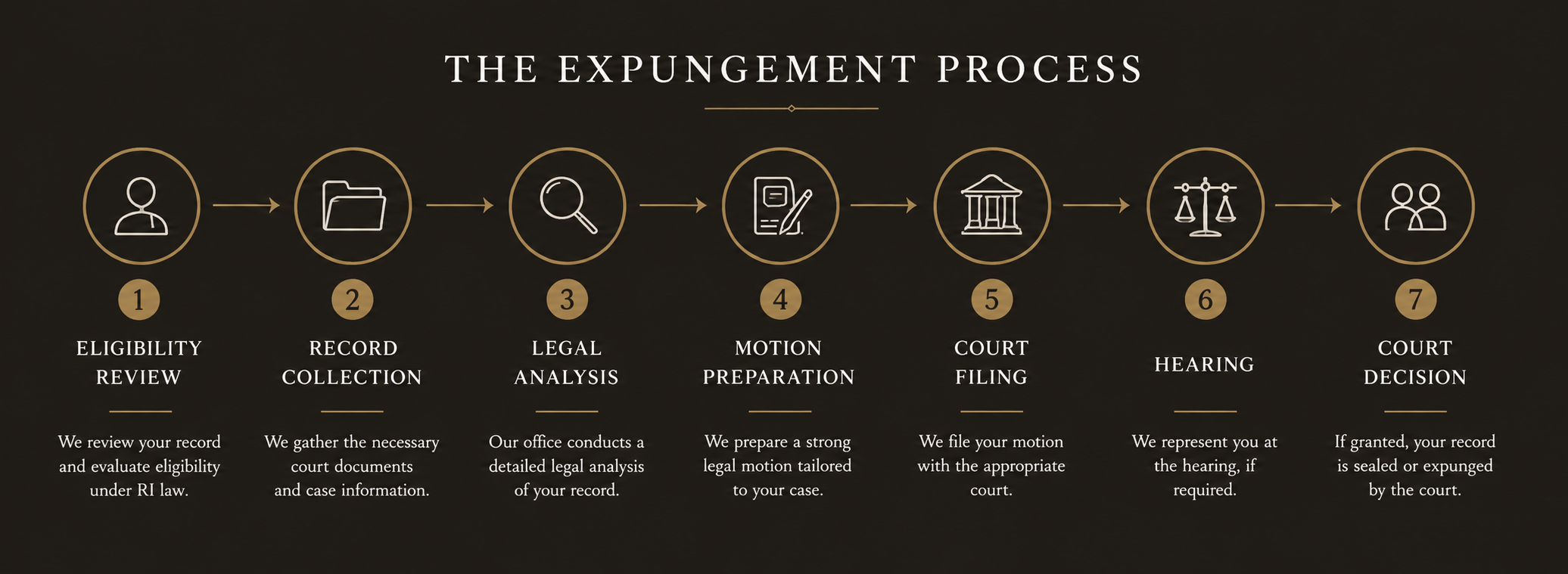
Yes. CK Law begins with a comprehensive review of your Rhode Island criminal record to determine which cases may be eligible for expungement or sealing and the appropriate legal basis for each request.
CK Law will not take your case unless we determine that there is a legal basis to pursue the requested relief. If your record does not currently qualify under Rhode Island law, we will explain why rather than have you spend time and money pursuing a motion that is not legally supported.
Our goal is to give you a clear and accurate assessment of your eligibility before moving forward.
-
Yes. Rhode Island expanded its expungement laws in 2026, creating a new path to expungement for certain individuals with multiple felony convictions.
The new legislation — 2026 Rhode Island House Bill 7079 (H 7079) and Senate Bill 3036 Substitute A (S 3036A) — allows certain individuals with more than one, but fewer than five felony convictions to petition the Court for expungement.
-
Item descUnder the new law, an individual with 2, 3, or 4 felony convictions may be eligible if the statutory requirements are satisfied, including:
15 years have passed since completion of the sentence for the most recent felony conviction;
The convictions do not include a “crime of violence” as defined by Rhode Island law;
The convictions do not include another offense specifically excluded from expungement under the statute;
The individual has not been arrested or convicted of a felony or misdemeanor during the required 15-year period;
There are no pending criminal proceedings against the individual; and
The individual can demonstrate rehabilitation and good character since the convictions.
-
Eligibility depends on several factors, including the type and number of convictions on your record, how the cases were resolved, and how much time has passed.
Rhode Island’s expungement laws have changed significantly over the years, so even if you were previously told that you were not eligible, it may be worth having your record reviewed again.