

RHODE ISLAND CRIMINAL DEFENSE
RHODE ISLAND DUI & CHEMICAL TEST REFUSAL DEFENSE
A DUI or chemical test refusal can have immediate consequences for your driver's license, criminal record, and future. Whether this is your first offense or you have prior charges, early legal representation allows the evidence to be carefully reviewed and the strongest possible defense strategy developed from the very beginning.

EXPERIENCED DEFENSE FOR RHODE ISLAND DUI CASES
Being arrested for driving under the influence can be overwhelming. From the moment of your arrest, strict deadlines, license issues, and criminal court proceedings begin moving quickly. Every decision made early in the case can affect the outcome.
At CK Law, every DUI case begins with a careful review of the traffic stop, police investigation, field sobriety testing, chemical testing, body camera footage, and constitutional issues that may affect the admissibility of evidence.
No two cases are alike. A successful defense often depends upon identifying legal issues that may not be immediately apparent.

What We Review
LEGALITY OF THE TRAFFIC STOP
Whether law enforcement had reasonable suspicion or probable cause to initiate the stop of the vehicle in question. This is the first layer of legal analysis.
FIELD SOBRIETY TESTING
Whether standardized field sobriety tests were conducted in accordance with standardized procedures and properly evaluated.
BREATH & CHEMICAL TESTING
Whether standardized field sobriety tests were conducted in accordance with standardized procedures and properly evaluated.
CONSTITUTIONAL PROTECTIONS
Whether your constitutional rights were violated during any stage of the investigation, including the stop, detention, arrest, or collection of evidence.

Chemical Test Refusal Cases
Rhode Island's implied consent law creates a separate legal proceeding at the Rhode Island Traffic Tribunal when a driver is alleged to have rejected a chemical breath test. This proceeding is a civil matter, however, can result in very serious implications.
A refusal allegation is distinct from the underlying DUI charge and may carry its own license consequences and legal issues. Although refusing a breath test does not automatically result in a DUI conviction, it can significantly affect both the criminal case and your driving privileges.
Because DUI and refusal matters frequently proceed simultaneously, developing a coordinated legal strategy is essential. A simple missed court date may result in a costly mistake that can be prevented with effective representation.
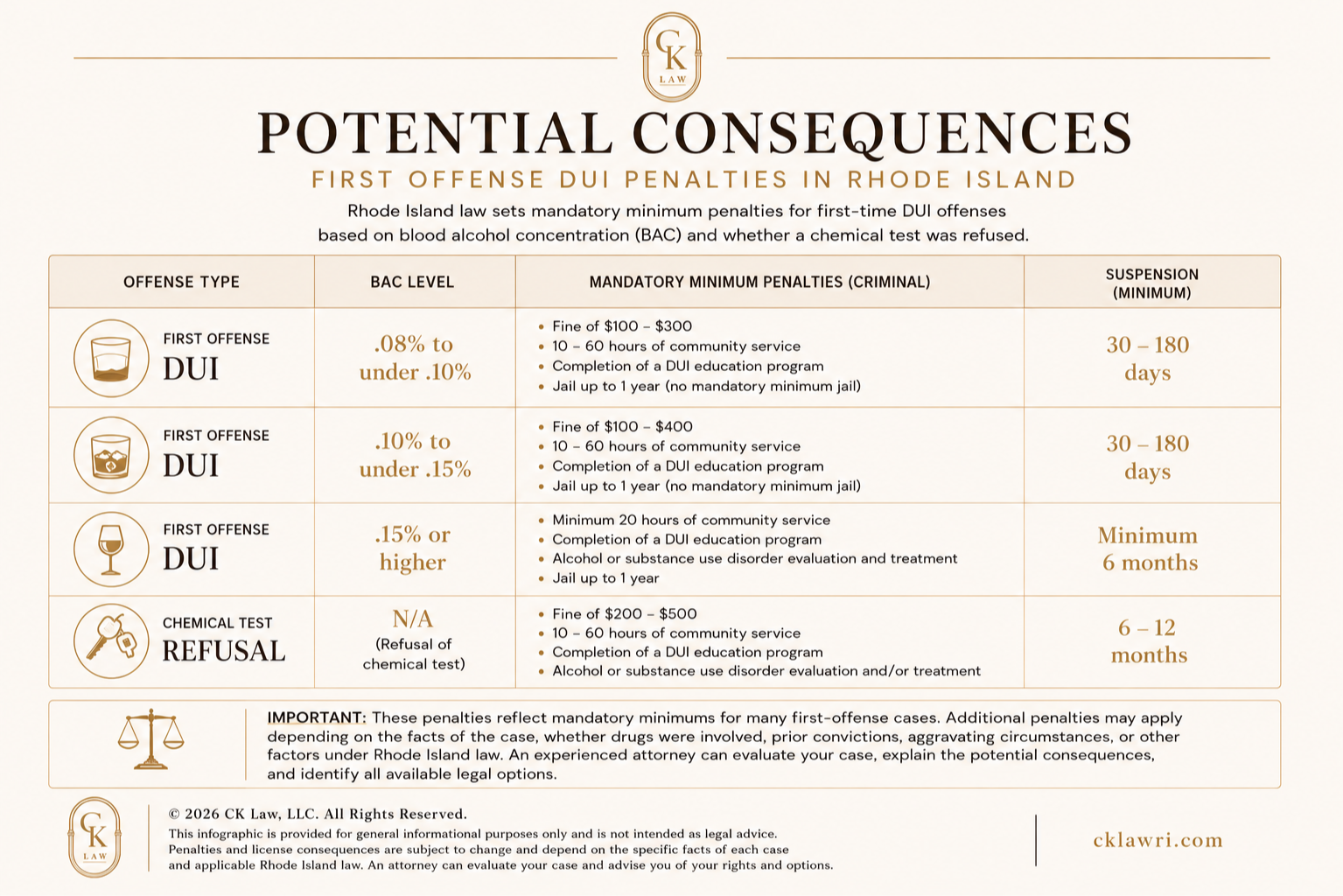
POTENTIAL LICENSE CONSEQUENCES
DUI Charges Can Affect Your Driving Privileges
A DUI or chemical test refusal can have consequences beyond the criminal charge itself. Rhode Island law imposes mandatory license suspensions that vary depending on the circumstances, including blood alcohol concentration, prior offenses, and whether a chemical test was refused.
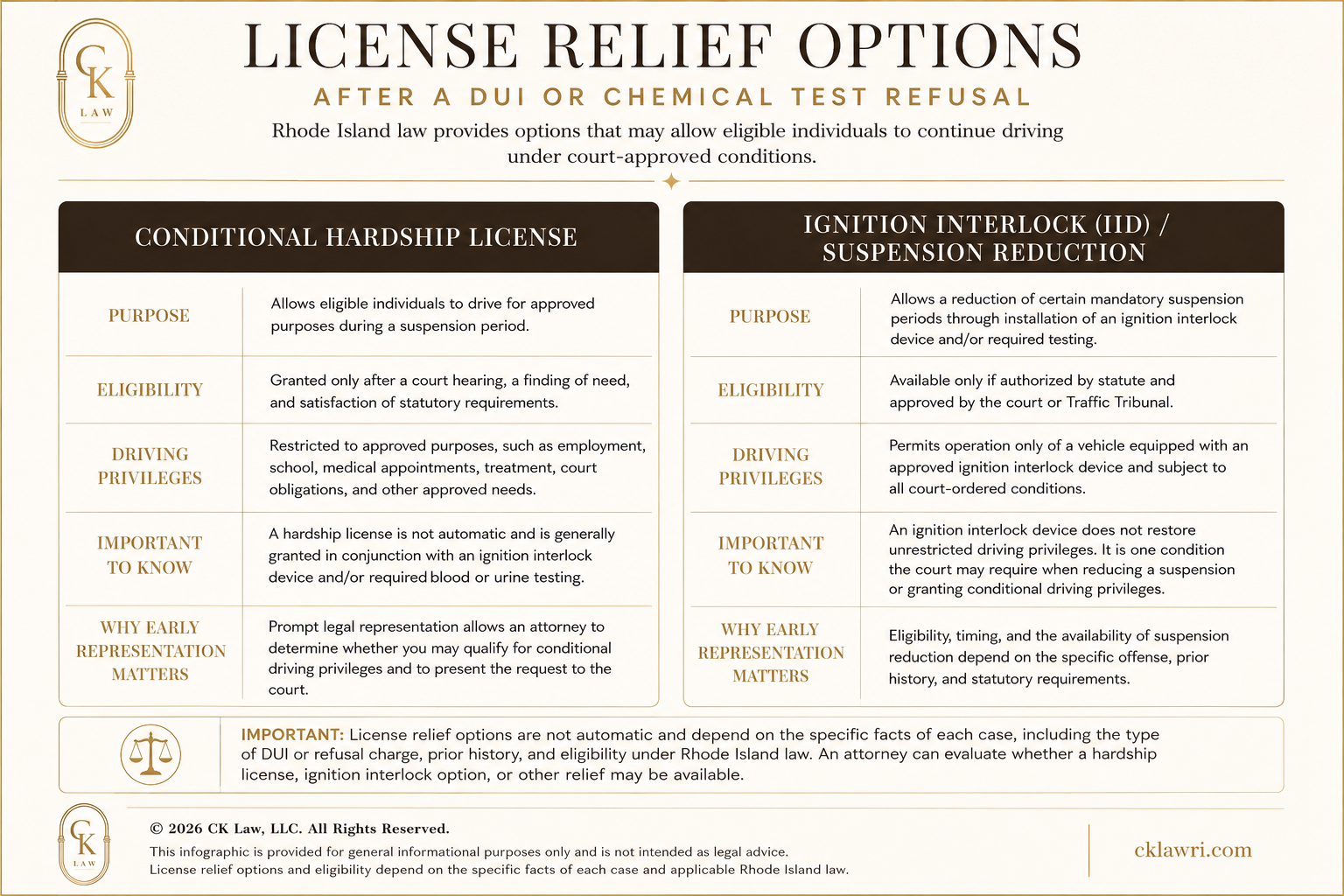
However, a suspension does not always mean you will be unable to drive for the entire suspension period. In appropriate cases, Rhode Island law provides options that may allow eligible individuals to continue driving under court-approved conditions.
Frequently Asked Questions
-
Yes. Whenever possible, legal representation should be obtained immediately after an arrest—and ideally before your first court appearance. Early representation allows an attorney to begin reviewing the evidence, identify potential legal issues, advise you regarding your rights and obligations, and begin developing a defense strategy before important decisions are made.
Time is especially important if your case also involves Rhode Island Traffic Tribunal citations or a chemical test refusal. These matters often proceed on separate tracks and may require prompt attention to protect your legal interests and driving privileges.
-
Yes. Refusing a chemical test does not prevent the State from pursuing a DUI charge.
Prosecutors may rely on other evidence, including the officer's observations, driving behavior, field sobriety testing, witness testimony, body camera footage, and other evidence obtained during the investigation.
The absence of a breath test does not automatically determine the outcome of a case, which is why every aspect of the investigation should be carefully reviewed.
-
Under Rhode Island's implied consent law, a chemical test refusal is separate from the underlying DUI charge and may result in its own legal proceedings and driver's license consequences.
Because refusal cases often move on a different timeline than the criminal case, swift legal representation is particularly important. An attorney can evaluate both matters together, explain the applicable procedures, and develop a coordinated strategy that addresses each case individually.
-
Every case must be independently evaluated based on its unique facts, the available evidence, and the applicable law. In many straightforward first-offense cases, there may be opportunities to resolve the matter through an outcome that results in the dismissal of either the criminal DUI charge or the related chemical test refusal proceeding before the Rhode Island Traffic Tribunal.
Whether this type of resolution is available depends on numerous factors, including the strength of the evidence, any constitutional or procedural issues, your prior record, and the specific circumstances of the case. Determining the best course of action requires a careful review of all available evidence and a thorough evaluation of every potential legal and strategic option before important decisions are made.
-
Not necessarily. License consequences depend upon the specific charges, your driving history, whether a chemical test was refused, and the outcome of your case.
In some circumstances, an attorney may be able to request that the court allow you to drive on a hardship license while your case is pending or during a period of suspension, if you meet the legal requirements.
A hardship license is a restricted driver's license that permits eligible individuals to drive for limited purposes, such as traveling to and from work, school, medical appointments, court-ordered treatment, or other approved obligations.
Because every case is different, obtaining legal advice early can help preserve available options and avoid unnecessary interruptions to your ability to work and meet family responsibilities.
-
Rhode Island law imposes substantially increased penalties for repeat DUI offenses. Prior DUI convictions within the applicable ten-year lookback period may result in higher fines, significantly longer driver's license suspensions, mandatory alcohol or substance use treatment, ignition interlock requirements, and mandatory periods of incarceration. A second DUI conviction carries a mandatory jail sentence, and a third or subsequent DUI within ten years is generally prosecuted as a felony under Rhode Island law.
If you are charged with Driving While License Suspended or Revoked for a DUI or Chemical Test Refusal, Rhode Island law also requires mandatory jail time upon conviction, making early legal representation especially important.
Repeat DUI cases frequently involve more complex legal and sentencing issues than first offenses. The specific penalties depend on your prior record, blood alcohol concentration, whether drugs were involved, and the particular facts of your case.
Because the consequences increase significantly with subsequent offenses, it is important to retain legal counsel as early as possible—preferably before your first court appearance. Early representation allows an attorney to evaluate the evidence, identify potential defenses, advise you regarding your driver's license, and explore all available legal options before critical decisions are made.